


























0
Views
0
Downloads

0 Likes
Calculating Average Atomic Mass: Chemistry Worksheet
0 Views
0 Downloads
Paste this activity's link or code into your existing LMS (Google Classroom, Canvas, Teams, Schoology, Moodle, etc.).
Students can open and work on the activity right away, with no student login required.
You'll still be able to track student progress and results from your teacher account.
Information
Description
What It Is:
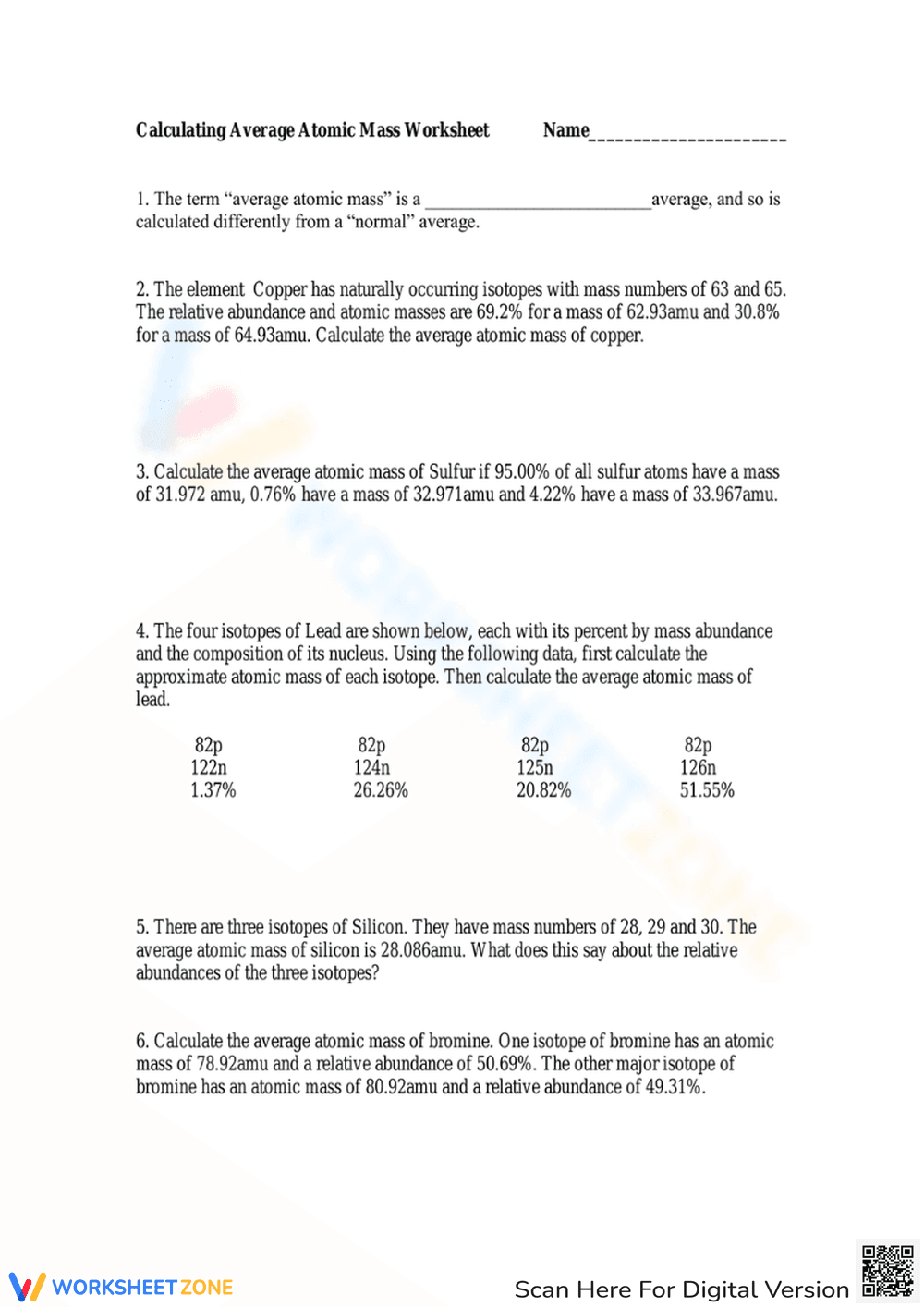
This is a worksheet titled 'Calculating Average Atomic Mass Worksheet.' It contains six problems related to calculating average atomic mass. The problems involve elements like Copper, Sulfur, Lead, Silicon, and Bromine. Students are asked to calculate the average atomic mass given isotopic masses and abundances, or to infer relative abundances from a known average atomic mass. Some questions require filling in blanks with definitions.
Grade Level Suitability:
This worksheet is suitable for high school chemistry, specifically grades 9-12. It requires understanding of isotopes, atomic mass, and weighted averages, which are typically covered in high school chemistry courses.
Why Use It:
This worksheet reinforces the concept of average atomic mass and provides practice in calculating it using isotopic masses and abundances. It helps students understand the relationship between isotopic abundance and average atomic mass. It also encourages critical thinking by asking students to infer relative abundances.
How to Use It:
Students should read the instructions and problems carefully. They need to use the provided data (isotopic masses and abundances) to calculate the average atomic mass for each element. For problem 5, students need to analyze the provided average atomic mass of silicon and infer the relative abundances of its isotopes. Students should show their work and write their answers clearly.
Target Users:
The target users are high school chemistry students who are learning about atomic structure, isotopes, and average atomic mass. It is also useful for teachers looking for practice problems to supplement their lessons on these topics.
This is a worksheet titled 'Calculating Average Atomic Mass Worksheet.' It contains six problems related to calculating average atomic mass. The problems involve elements like Copper, Sulfur, Lead, Silicon, and Bromine. Students are asked to calculate the average atomic mass given isotopic masses and abundances, or to infer relative abundances from a known average atomic mass. Some questions require filling in blanks with definitions.
Grade Level Suitability:
This worksheet is suitable for high school chemistry, specifically grades 9-12. It requires understanding of isotopes, atomic mass, and weighted averages, which are typically covered in high school chemistry courses.
Why Use It:
This worksheet reinforces the concept of average atomic mass and provides practice in calculating it using isotopic masses and abundances. It helps students understand the relationship between isotopic abundance and average atomic mass. It also encourages critical thinking by asking students to infer relative abundances.
How to Use It:
Students should read the instructions and problems carefully. They need to use the provided data (isotopic masses and abundances) to calculate the average atomic mass for each element. For problem 5, students need to analyze the provided average atomic mass of silicon and infer the relative abundances of its isotopes. Students should show their work and write their answers clearly.
Target Users:
The target users are high school chemistry students who are learning about atomic structure, isotopes, and average atomic mass. It is also useful for teachers looking for practice problems to supplement their lessons on these topics.


