


























1 / 3
0
Views
0
Downloads



0.0
0
0 Likes
Dihybrid Cross Genetics Worksheet
0 Views
0 Downloads
Paste this activity's link or code into your existing LMS (Google Classroom, Canvas, Teams, Schoology, Moodle, etc.).
Students can open and work on the activity right away, with no student login required.
You'll still be able to track student progress and results from your teacher account.
Information
Description
What It Is:
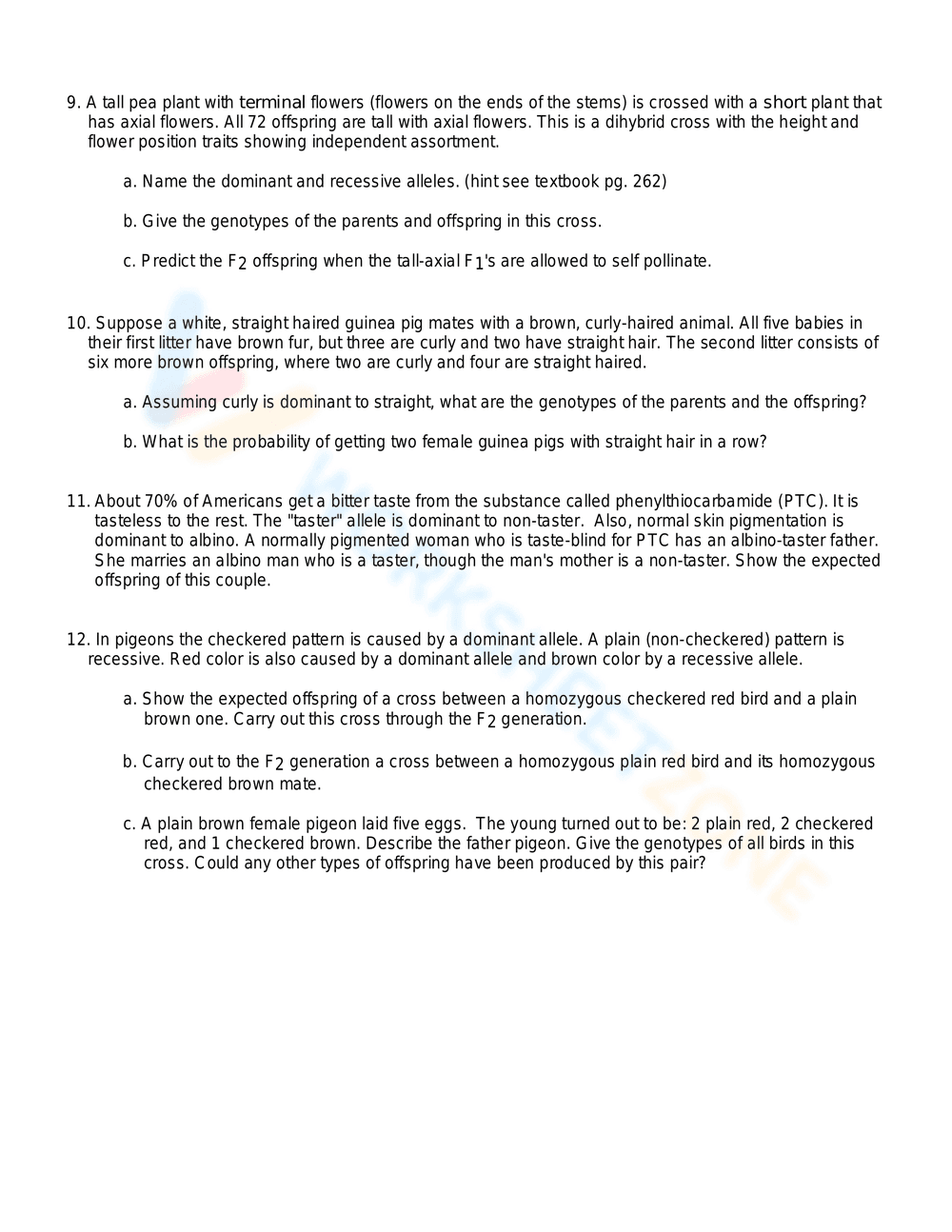
This is a dihybrid cross worksheet. It contains four multi-part genetics problems where students are asked to set up Punnett squares based on provided information about dominant and recessive alleles. The problems involve traits for plant height and flower color, as well as fur color and texture in guinea pigs. Students must then use their Punnett squares to determine probabilities and possible genotypes for various offspring traits. The worksheet provides empty 4x4 Punnett squares for students to complete.
Grade Level Suitability:
This worksheet is most suitable for high school biology, specifically grades 9-12. It requires an understanding of Mendelian genetics, dominant and recessive alleles, genotypes, phenotypes, and the use of Punnett squares, which are typically covered in high school biology courses.
Why Use It:
This worksheet helps students practice and reinforce their understanding of dihybrid crosses. It allows them to apply their knowledge of genetics to solve problems, predict offspring traits, and calculate probabilities. It also improves their problem-solving skills and ability to interpret genetic information.
How to Use It:
Students should first carefully read the provided information for each problem, identifying the dominant and recessive alleles for each trait. They should then set up a 4x4 Punnett square, placing the alleles of each parent along the top and side of the square. Next, they should fill in the squares with the resulting genotypes. Finally, they should use the Punnett square to answer the questions about probabilities and possible genotypes for each problem.
Target Users:
The target users are high school biology students learning about Mendelian genetics and dihybrid crosses. It can also be used as a review or practice activity for students who have already learned about these concepts.
This is a dihybrid cross worksheet. It contains four multi-part genetics problems where students are asked to set up Punnett squares based on provided information about dominant and recessive alleles. The problems involve traits for plant height and flower color, as well as fur color and texture in guinea pigs. Students must then use their Punnett squares to determine probabilities and possible genotypes for various offspring traits. The worksheet provides empty 4x4 Punnett squares for students to complete.
Grade Level Suitability:
This worksheet is most suitable for high school biology, specifically grades 9-12. It requires an understanding of Mendelian genetics, dominant and recessive alleles, genotypes, phenotypes, and the use of Punnett squares, which are typically covered in high school biology courses.
Why Use It:
This worksheet helps students practice and reinforce their understanding of dihybrid crosses. It allows them to apply their knowledge of genetics to solve problems, predict offspring traits, and calculate probabilities. It also improves their problem-solving skills and ability to interpret genetic information.
How to Use It:
Students should first carefully read the provided information for each problem, identifying the dominant and recessive alleles for each trait. They should then set up a 4x4 Punnett square, placing the alleles of each parent along the top and side of the square. Next, they should fill in the squares with the resulting genotypes. Finally, they should use the Punnett square to answer the questions about probabilities and possible genotypes for each problem.
Target Users:
The target users are high school biology students learning about Mendelian genetics and dihybrid crosses. It can also be used as a review or practice activity for students who have already learned about these concepts.


