


























This lesson discusses the concept of inverse functions and how they can be used in both real life and more abstract situations. Students will:
- find the inverses of functions.
- understand the relationship between a graph of a function and its inverse.
- How can the inverse of a linear function be found and expressed?
- Inverse Function: The function obtained by expressing the independent variable in terms of the dependent.
- graph paper marked with the line x = y as a dashed line (M-A2-6-2_Graph Paper)
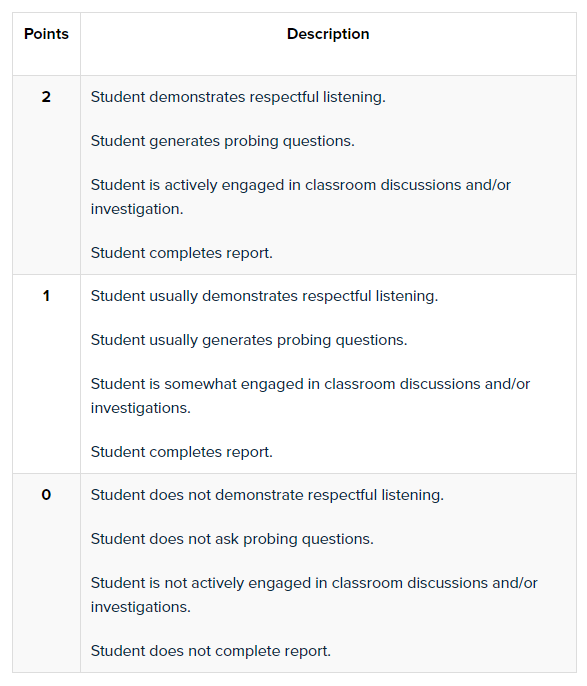
- Evaluate student performance in the heart-rate activity by comparing substitutes for age and resting heart rate, computing maximum heart rate, and determining whether the findings are plausible.
- Encourage students to self-evaluate their temperature activity outcomes by determining whether they are realistic based on their prior knowledge of the Celsius and Fahrenheit temperature ranges. Point out that the indoor temperature is around 20 degrees Celsius.
Active Engagement, Modeling, and Explicit Instruction
W: This lesson teaches students to express functions and their inverses in various ways, understand them meaningfully, and apply them to real-world situations.
H: The example y = 3x + 2 prompts students to consider both representing and expressing y in terms of x. Since the mechanics of a function's inverse begin with that principle, students receive an introduction that has both operational and conceptual relevance.
E: The maximum heart rate activity uses the inverse of functions to help students understand the relationship between resting heart rate, maximum heart rate, and age.
R: To properly comprehend the behavior of the maximum heart rate function, students must be flexible in their reasoning about how changes in one variable affect the others. To make sense of these results, they will perform operations that reverse earlier ones. Similar processing helps them understand the function and inverse relationship between Celsius and Fahrenheit temperatures.
E: After completing the Celsius and Fahrenheit temperature exercise, assess students' oral explanations of function and its inverse. Ask them to identify other types of relationships with inverses that make sense to them. Use a qualitative rather than quantitative standard to get a sense of how they can relate one variable to another and how changing the independent variable affects the results for both the original function and its inverse.
T: Identify students who need extra help comprehending inverses and help them voice their questions to encourage small group discussions and assure comprehension. Furthermore, the numerous activities are designed for different types of learners. The initial activity of writing directions is geared toward spatial reasoning, the action of measuring heart rate is geared toward kinesthetic learners, the algebraic process of finding inverses is geared toward abstract learners, and the overall discussion is geared toward verbal and auditory learners.
O: The introduction begins with tangible examples, which are explained by the teacher and examined by students. These concrete instances are finally represented by abstract algebraic formulas, yet they remain relevant to the specific topics they represent. When working on finding inverses, show the technique to the class before breaking them into groups to ensure that students are prepared and capable of finding inverse functions on their own.
We use inverse functions on a daily basis; for example, if a friend provides you directions from your house to his/her house, you invert those directions to return home. Mathematical inverses are carefully specified, although that definition isn't required to investigate and comprehend the underlying concepts.
Start the class with an example: write the following function on the board: y = 3x + 2. Tell the class that we can use this function to find y values given some x values. But what if we're given the y values but need to determine the x instead? Instead, we can solve the function for x as follows (demonstrated on the board):
For y = 3x + 2, to solve for x, subtract 2 from both sides.
For y - 2 = 3x, divide by 3 to find x.
For \(y - 2 \over 3\) = x, the function is now set up using x in terms of y.
"Now that we've seen an example of a linear function, let's look at a more general method for finding linear functions, using the function y = 2x + 5 as an example. The first step is to swap x and y, resulting in our function x = 2y + 5. Now we just need to solve for y."
Work through a few examples with the class (just using linear functions). Before starting the upcoming group activity, ask the students:
"Let's review for a moment: when we need to graph a linear equation like y = 2x + 5, how can we do it?" (plotting points, determining intercepts, and applying slope-intercept form)
"Now let's look at inverses in another sense." On the board, direct students from your school to a nearby landmark. Have them write the directions from the landmark to the school. (You might also use directions from one classroom to another, the gymnasium, cafeteria, library, and so on.) Explain that these "backwards" directions are a good example of today's topic, which is functions and their inverses.
Lead a general discussion about health and exercise: Is everyone aware that the heart is a muscle? To maintain a healthy heart muscle, we must exercise it by running or engaging in other kinds of exercise. Trainers understand that each body is unique, and one of the distinctions between people is their resting heart rate. Explain how to find your resting heart rate.
Find your pulse on your wrist or neck (just beneath the jaw). Use two fingers to get a better feel. When you say so, have students start counting their pulses and record them for 15 seconds. After 15 seconds, ask them to note the number of beats on a piece of paper.
Repeat this activity four or five times, with students recording their resting heart rate (RHR) each time. Then have students calculate the average of their resting heart rate. Have a student explain how to calculate the average of a group of numbers.
Inform students that RHR is typically expressed as beats per minute, not beats per 15 seconds. Students can convert their average from beats per 15 seconds to beats per minute by multiplying by 4 (4 × 15 sec = 60 sec = 1 min). Students should record their resting heart rate on paper, clearly writing "RHR = 60 bpm" (or whatever their RHR is).
Tell students, "Your maximum heart rate is another significant heart rate measurement. There is a formula to express maximum heart rate (abbreviated MHR), because it is impossible to know if you have reached your maximum heart rate simply by exercising." Give students the formula for maximum heart rate:
220 − age − 0.3RHR = MHR
Each student should use the formula to calculate his or her personal maximum heart rate. Have students substitute 14 for their age and explain that we'll use that to be more consistent. To personalize the formula, have them utilize their respective resting heart rates. Remind them to follow the order of operations and complete the computation inside the parentheses first.
Inform students that this formula is an average for a large group of people. The maximum heart rate for any one individual may vary among those with the same ages and resting heart rates.
Ask for a volunteer to come to the front of the class and share his or her MHR. Students should form groups and try to guess the volunteer's RHR. Begin a table listing this volunteer's MHR and RHR. Repeat this multiple times until you notice students identifying patterns. If someone tells you his or her MHR, ask the class to come up with a way to calculate their RHR using the preceding formula. Encourage students to consider "undoing" the procedures performed on the RHR in order to reach MHR.
Instruct groups to write out their "system" for determining RHR given MHR: students will most likely write down what they've done.
If a student group has used algebra to do the calculation, ask those students to present to the class; otherwise, demonstrate how we can use algebra to solve the formula.
MHR = 206 – 0.3RHR.
for RHR, guide students through "undoing" the addition of 206 and the multiplication by -0.3 to achieve the formula.
Explain that the two formulas are inverses, and ask students to generate a table for the first function using RHR values of 30, 40, 50, and 60.
MHR = 206 – 0.3RHR.
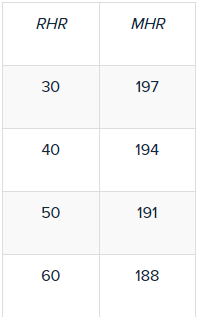
Then, have them substitute the MHR values they obtained into the inverse function to see what they get for RHR. They should take note that they receive 30, 40, 50, and 60.
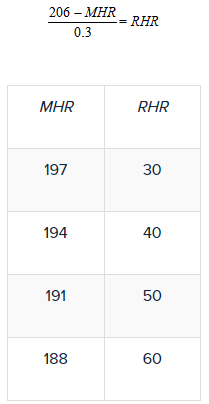
"What is the relationship between the two tables?" (They are opposites; the two rows/columns have been reversed; etc.)
Use examples from everyday life to generate concepts for inversions and inverting (for example, following map directions in reverse), then remind students that mathematics is about precision, thus we must be accurate with our language and terminology.
At the start of the class, remind students of the definition of an inverse function.
Inverse Functions: two functions that "undo" each other.
To invert: to undo.
Before going, go over the definitions of opposite, reciprocal, and inverse with students to ensure they understand the differences (and similarities). Explain that these words may appear to be the same in less-precise language, but in mathematical terms, while they are all related, each has a very separate and precise meaning.
"Now, we'll look at another formula and talk about its inverse."
Introduce the formula
F = (\(9 \over 5\))C + 32
to the class and explain that the input temperature is in degrees Celsius and the output temperature is in Fahrenheit.
To help students practice the formula, explain that water boils at 100 degrees Celsius. Ask students to apply the formula to calculate the boiling point of water in Fahrenheit. (This can be repeated with the data that water freezes at 0 degrees Celsius, although many students will already know that water freezes at 32 degrees Fahrenheit without using the formula.)
Now ask them to apply this method to figure out what Celsius temperature is equivalent to 98 degrees Fahrenheit. Students should be aware that determining takes some effort because the formula is designed to accept Celsius temperatures rather than Fahrenheit. Remind students that by determining the inverse, we essentially "flip" the inputs and outputs.
"If we want to use a formula that has Fahrenheit temperatures as inputs and Celsius temperatures as outputs, we should find the inverse of the given function."
Use algebra and inverse procedures to find the formula.
C = (\(5 \over 9\)) (F - 32)
Now ask them to determine a Celsius temperature that is equal to 98 degrees Fahrenheit. (The answer should be \(36 {2 \over 3} \).) Also, ask them to confirm that 100 degrees Celsius and 212 degrees Fahrenheit are equivalent.
(Depending on the class and time limits, students may also be required to discover the temperature that is equal in Celsius and Fahrenheit. The solution is -40 degrees.)
Make sure that students remember how to graph lines, then divide the class into groups and distribute graph paper with a dashed line indicating y = x already marked on it (M-A2-6-2_Graph Paper). First, have each group collaborate to discover the inverse of a function. After they're certain they've found the inverse, have them plot the original function and the inverse on the same graph.
Students should practice this activity several times (each time on a new sheet of graph paper with x = y marked on it). Ask students to explain in their own words the difference between y = x and x = y. Also, ask if this is the same kind of relationship as 4 + 1 = 5 and 5 = 4 + 1.
After each group has completed the activity two or three times, ask the students:
"What do you notice about the graph of the original linear function and its inverse?" (They cross on the dashed line; they are reflections across the dashed line.)
Students should choose a graph from their groups and compute the y-coordinate for the original function when x = 2. Then, have them calculate the y-coordinate for the inverse function, using the y-coordinate they just discovered as the new x-coordinate.
"What do you notice about the two ordered pairs?" (They are opposites; the x and y coordinates are reversed.)
Ask students to find the dashed line (y = x) on their graph paper. It should be noted that on this line, reversing the x- and y-coordinates has no effect. Explain how the fact that the two coordinates are the same for each point on the dashed line contributes to the line's role as the line of reflection for inverse functions.
"As previously noted, functions can be represented in a variety of ways, including tables, equations, and graphs. We've now explored how inverse functions appear in each of these forms."
Students should volunteer to describe how to find inverses if they begin with any of the three formats presented in the lesson: tables, equations, or graphs. Ask students which form they prefer, and remind them that they can often swap between forms. For example, if they have a graphed equation and need to draw the graph of the inverse function, they can compute the inverse algebraically and then graph that equation if they like, or they can create a table of values, reverse the x and y columns, and graph the new points.
Extension:
All conversion factors in measures are functions that can be utilized in a similar way to Fahrenheit/Celsius temperature representations. One quart = 0.946333 liters, one mile = 1.60935 kilometers, and one pound = 453.5924 grams.
Use the equivalence of 1 quart and 0.946333 liters as a function: the number of quarts multiplied by the factor 0.946333 equals the number of liters. In other words:
Quarts × 0.946333 = Liters.
0.946333 . Q = L
How many liters are in 18 quarts? (0.946333) × 18 = 17.033994 liters.
Consider which unit is larger, quart or liter, to determine whether your result is reasonable. Since one quart is smaller than one liter, the number of liters must be less than the number of quarts. Since 17 < 18, this makes sense.
Use the conversion factors listed above to assign these representations.
How many pounds in 1 gram? [0.0022]
How many quarts are in 18 liters? [19.0208]
How many miles are in 77 kilometers? [47.8454]

Exploring Inverses of Linear Functions
This is an educational worksheet titled 'Inverses of Linear Functions (M-A2-6-2)'. It includes objectives, core questions, vocabulary (specifically the definition of 'Inverse Function'), a list of materials (graph paper), assessment suggestions, and suggested supports like active engagement, modeling, and explicit instruction. The assessment section describes activities related to heart rate and temperature evaluation.
Grade Level Suitability:
This worksheet is suitable for high school students, specifically grades 9-12. The concepts of inverse functions, linear functions, and their graphs are typically taught in Algebra 1 or Algebra 2. The assessment tasks involving heart rate and temperature conversions also align with high school level science and math skills.
Why Use It:
This worksheet helps students understand the concept of inverse functions, their relationship to the original function's graph, and how to find and express them. It also connects abstract math concepts to real-life applications through heart rate and temperature activities. The inclusion of vocabulary and suggested supports aids in comprehension and instruction.
How to Use It:
Use the worksheet as a guide for a lesson on inverse functions. Begin by discussing the objectives and core questions. Introduce the vocabulary term 'Inverse Function'. Have students use graph paper to graph functions and their inverses. Implement the heart rate and temperature activities for assessment. Utilize the suggested supports to enhance student engagement and understanding.
Target Users:
The target users are high school math teachers teaching Algebra 1 or Algebra 2, as well as students learning about inverse functions. It is also useful for students who need to review or reinforce their understanding of this concept.


