


























0
Views
0
Downloads

0.0
0
0 Likes
Identify Ionic or Molecular Compounds
0 Views
0 Downloads
Paste this activity's link or code into your existing LMS (Google Classroom, Canvas, Teams, Schoology, Moodle, etc.).
Students can open and work on the activity right away, with no student login required.
You'll still be able to track student progress and results from your teacher account.
Information
Description
What It Is:
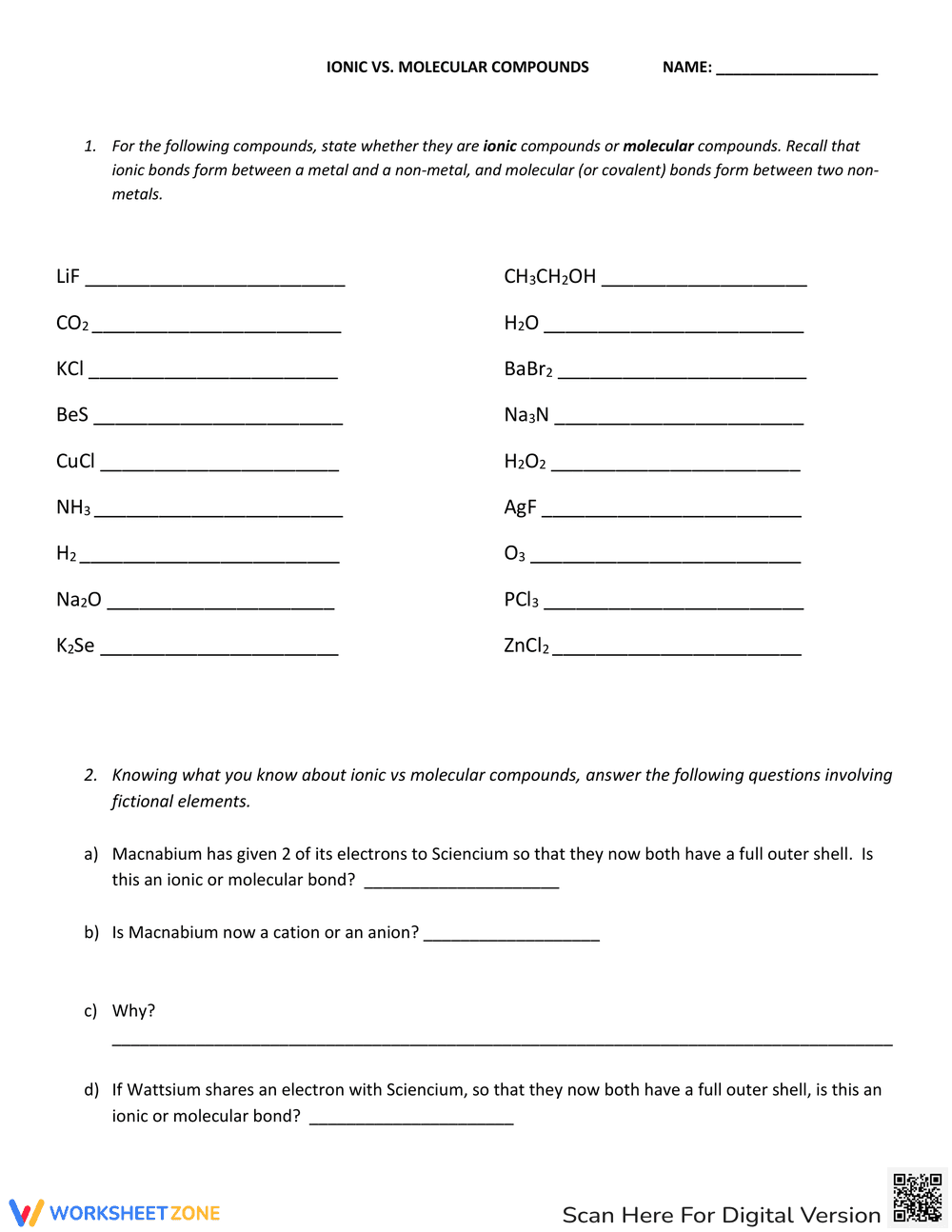
This is a chemistry worksheet focusing on ionic and molecular compounds. The first section requires students to identify whether given compounds (e.g., LiF, CO2, KCl, CH3CH2OH, H2O) are ionic or molecular. The second section presents scenarios involving fictional elements (Macnabium and Sciencium) and asks students to determine the type of bond formed and the resulting ions.
Grade Level Suitability:
This worksheet is suitable for high school chemistry students, typically grades 9-12. It requires understanding of chemical bonding principles, including the difference between ionic and molecular bonds, and the concepts of cations and anions.
Why Use It:
This worksheet reinforces the understanding of ionic and molecular compounds and their formation. It helps students apply the rules for identifying ionic and molecular compounds and promotes critical thinking about the transfer and sharing of electrons in chemical bonding. The use of fictional elements encourages conceptual understanding rather than rote memorization.
How to Use It:
Students should first review the definitions of ionic and molecular compounds. For the first section, they should analyze each compound and determine whether it's formed between a metal and non-metal (ionic) or between two non-metals (molecular). For the second section, they should read each scenario carefully and apply their knowledge of electron transfer and sharing to answer the questions.
Target Users:
The target users are high school chemistry students learning about chemical bonding, ionic and molecular compounds, cations, and anions. It is also useful for teachers needing supplementary materials for their chemistry lessons.
This is a chemistry worksheet focusing on ionic and molecular compounds. The first section requires students to identify whether given compounds (e.g., LiF, CO2, KCl, CH3CH2OH, H2O) are ionic or molecular. The second section presents scenarios involving fictional elements (Macnabium and Sciencium) and asks students to determine the type of bond formed and the resulting ions.
Grade Level Suitability:
This worksheet is suitable for high school chemistry students, typically grades 9-12. It requires understanding of chemical bonding principles, including the difference between ionic and molecular bonds, and the concepts of cations and anions.
Why Use It:
This worksheet reinforces the understanding of ionic and molecular compounds and their formation. It helps students apply the rules for identifying ionic and molecular compounds and promotes critical thinking about the transfer and sharing of electrons in chemical bonding. The use of fictional elements encourages conceptual understanding rather than rote memorization.
How to Use It:
Students should first review the definitions of ionic and molecular compounds. For the first section, they should analyze each compound and determine whether it's formed between a metal and non-metal (ionic) or between two non-metals (molecular). For the second section, they should read each scenario carefully and apply their knowledge of electron transfer and sharing to answer the questions.
Target Users:
The target users are high school chemistry students learning about chemical bonding, ionic and molecular compounds, cations, and anions. It is also useful for teachers needing supplementary materials for their chemistry lessons.


