


























0
Views
0
Downloads

0.0
0
0 Likes
Plant Cell Labeling Worksheet
0 Views
0 Downloads
Paste this activity's link or code into your existing LMS (Google Classroom, Canvas, Teams, Schoology, Moodle, etc.).
Students can open and work on the activity right away, with no student login required.
You'll still be able to track student progress and results from your teacher account.
Information
Description
What It Is:
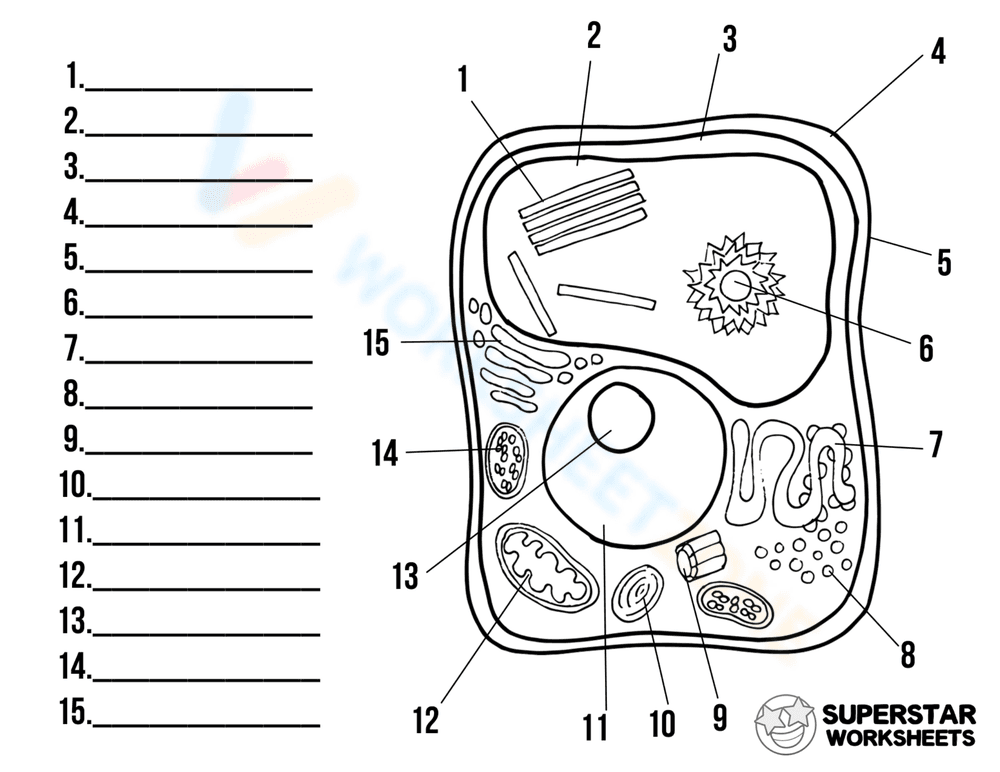
This is a biology worksheet featuring a diagram of a plant cell. The worksheet requires students to label 15 different parts of the cell. The diagram shows structures like the cell wall, cell membrane, nucleus, endoplasmic reticulum, Golgi apparatus, mitochondria, chloroplasts, ribosomes, and other organelles. There are numbered lines pointing to each structure with a corresponding numbered list on the left side of the page for students to write their answers.
Grade Level Suitability:
This worksheet is most suitable for grades 6-9. It introduces and reinforces the basic structures of a plant cell, which is a common topic in middle school and early high school biology courses. The complexity of the cell and the number of parts to label suggest it's appropriate for students with some prior knowledge of cell biology.
Why Use It:
This worksheet helps students learn and memorize the different parts of a plant cell and their locations. It improves understanding of cell structure and function, develops vocabulary related to cell biology, and provides practice in identifying cell organelles. It also enhances visual learning and reinforces the concepts through labeling.
How to Use It:
Students should use their textbook, notes, or other resources to identify each numbered structure in the plant cell diagram. They should then write the name of the corresponding cell part next to the matching number on the left-hand side of the worksheet. The completed worksheet can be used for review or assessment.
Target Users:
The target users are middle school and early high school students studying biology. It is also useful for teachers as a supplemental activity or assessment tool to reinforce cell biology concepts. Students who benefit from visual learning or need extra practice identifying cell structures will find this worksheet helpful.
This is a biology worksheet featuring a diagram of a plant cell. The worksheet requires students to label 15 different parts of the cell. The diagram shows structures like the cell wall, cell membrane, nucleus, endoplasmic reticulum, Golgi apparatus, mitochondria, chloroplasts, ribosomes, and other organelles. There are numbered lines pointing to each structure with a corresponding numbered list on the left side of the page for students to write their answers.
Grade Level Suitability:
This worksheet is most suitable for grades 6-9. It introduces and reinforces the basic structures of a plant cell, which is a common topic in middle school and early high school biology courses. The complexity of the cell and the number of parts to label suggest it's appropriate for students with some prior knowledge of cell biology.
Why Use It:
This worksheet helps students learn and memorize the different parts of a plant cell and their locations. It improves understanding of cell structure and function, develops vocabulary related to cell biology, and provides practice in identifying cell organelles. It also enhances visual learning and reinforces the concepts through labeling.
How to Use It:
Students should use their textbook, notes, or other resources to identify each numbered structure in the plant cell diagram. They should then write the name of the corresponding cell part next to the matching number on the left-hand side of the worksheet. The completed worksheet can be used for review or assessment.
Target Users:
The target users are middle school and early high school students studying biology. It is also useful for teachers as a supplemental activity or assessment tool to reinforce cell biology concepts. Students who benefit from visual learning or need extra practice identifying cell structures will find this worksheet helpful.


