


























1 / 2
0
Views
0
Downloads


0.0
0
0 Likes
Introduction to Genetics Vocabulary Worksheet
0 Views
0 Downloads
Paste this activity's link or code into your existing LMS (Google Classroom, Canvas, Teams, Schoology, Moodle, etc.).
Students can open and work on the activity right away, with no student login required.
You'll still be able to track student progress and results from your teacher account.
Information
Description
What It Is:
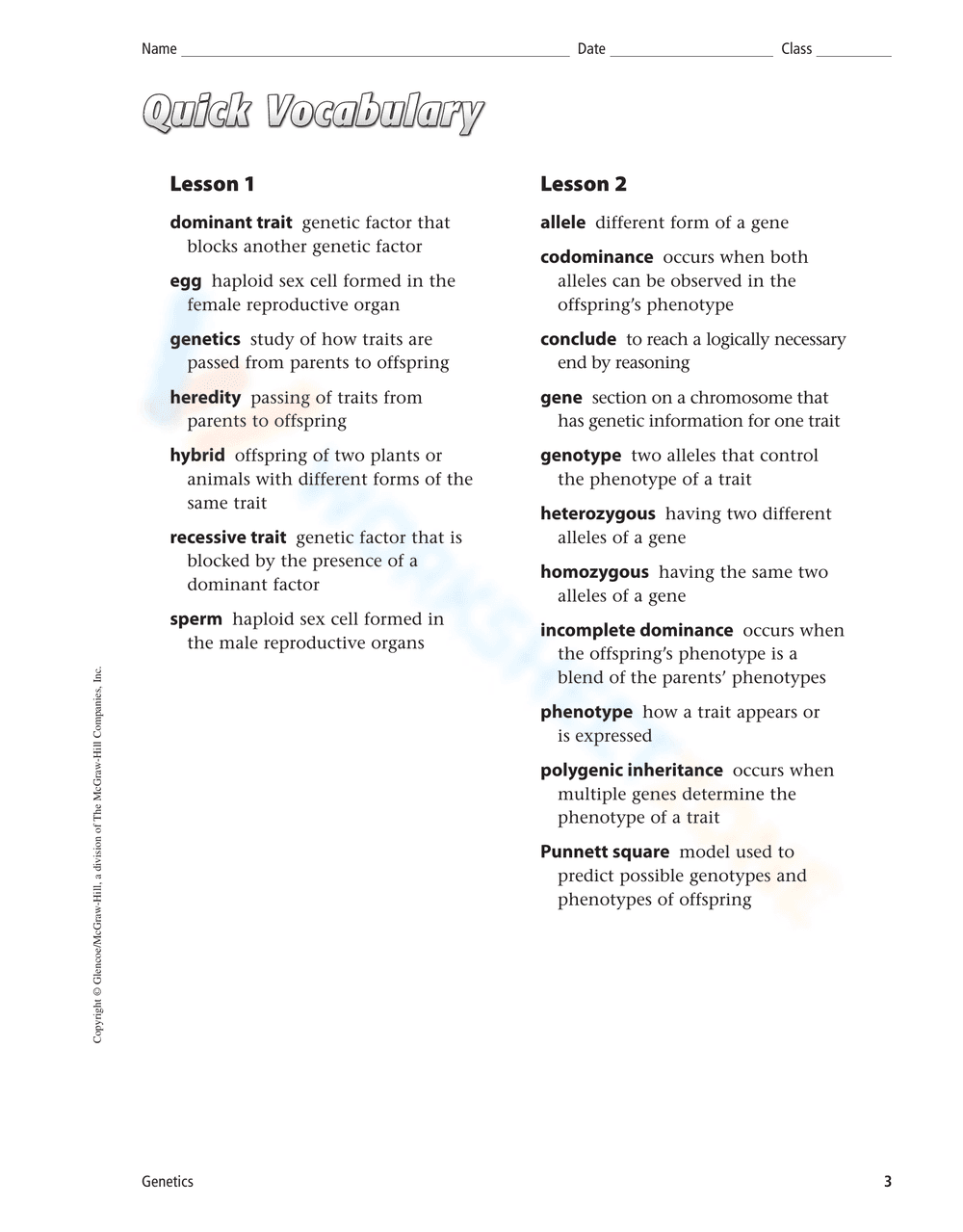
This is a vocabulary worksheet focused on genetics. It includes two lessons, each defining key terms related to heredity and genetic traits. Lesson 1 includes terms like 'dominant trait,' 'egg,' 'genetics,' 'heredity,' 'hybrid,' 'recessive trait,' and 'sperm.' Lesson 2 covers 'allele,' 'codominance,' 'conclude,' 'gene,' 'genotype,' 'heterozygous,' 'homozygous,' 'incomplete dominance,' 'phenotype,' 'polygenic inheritance,' and 'Punnett square.' Each term is followed by a brief definition.
Grade Level Suitability:
This worksheet is suitable for middle school (grades 6-8) and high school (grades 9-12) students. The vocabulary and concepts presented are foundational to understanding genetics and heredity, typically covered in science courses at these levels. The definitions are concise and appropriate for these age groups.
Why Use It:
This worksheet helps students build a strong vocabulary base for understanding genetics. It introduces and defines essential terms, enabling students to comprehend more complex genetic concepts. It's a useful tool for pre-teaching, review, or reinforcement of key vocabulary.
How to Use It:
Students can use this worksheet as a reference guide while learning about genetics. It can be used for individual study, group review, or as part of a classroom lesson. Students can read the definitions, create flashcards, or use the terms in sentences to enhance their understanding. It can also be used as a quick quiz or review tool by covering the definitions and having students identify the terms.
Target Users:
The target users are middle school and high school students learning about genetics and heredity. It is also beneficial for science teachers looking for a concise vocabulary resource for their students.
This is a vocabulary worksheet focused on genetics. It includes two lessons, each defining key terms related to heredity and genetic traits. Lesson 1 includes terms like 'dominant trait,' 'egg,' 'genetics,' 'heredity,' 'hybrid,' 'recessive trait,' and 'sperm.' Lesson 2 covers 'allele,' 'codominance,' 'conclude,' 'gene,' 'genotype,' 'heterozygous,' 'homozygous,' 'incomplete dominance,' 'phenotype,' 'polygenic inheritance,' and 'Punnett square.' Each term is followed by a brief definition.
Grade Level Suitability:
This worksheet is suitable for middle school (grades 6-8) and high school (grades 9-12) students. The vocabulary and concepts presented are foundational to understanding genetics and heredity, typically covered in science courses at these levels. The definitions are concise and appropriate for these age groups.
Why Use It:
This worksheet helps students build a strong vocabulary base for understanding genetics. It introduces and defines essential terms, enabling students to comprehend more complex genetic concepts. It's a useful tool for pre-teaching, review, or reinforcement of key vocabulary.
How to Use It:
Students can use this worksheet as a reference guide while learning about genetics. It can be used for individual study, group review, or as part of a classroom lesson. Students can read the definitions, create flashcards, or use the terms in sentences to enhance their understanding. It can also be used as a quick quiz or review tool by covering the definitions and having students identify the terms.
Target Users:
The target users are middle school and high school students learning about genetics and heredity. It is also beneficial for science teachers looking for a concise vocabulary resource for their students.


